

Regional trade fairs gather the companies in a sector in one place and, usually, publish who they are. For an exporter, that list is useful research whether or not you attend. It works best when you are clear about who is on it and why.
A directory is a starting point.
- Identify the role
An exhibitor may be a seller, distributor or competitor.
- Research the company
Check its own website and the directory’s terms.
- Make an honest approach
Only refer to a meeting if it actually happened.
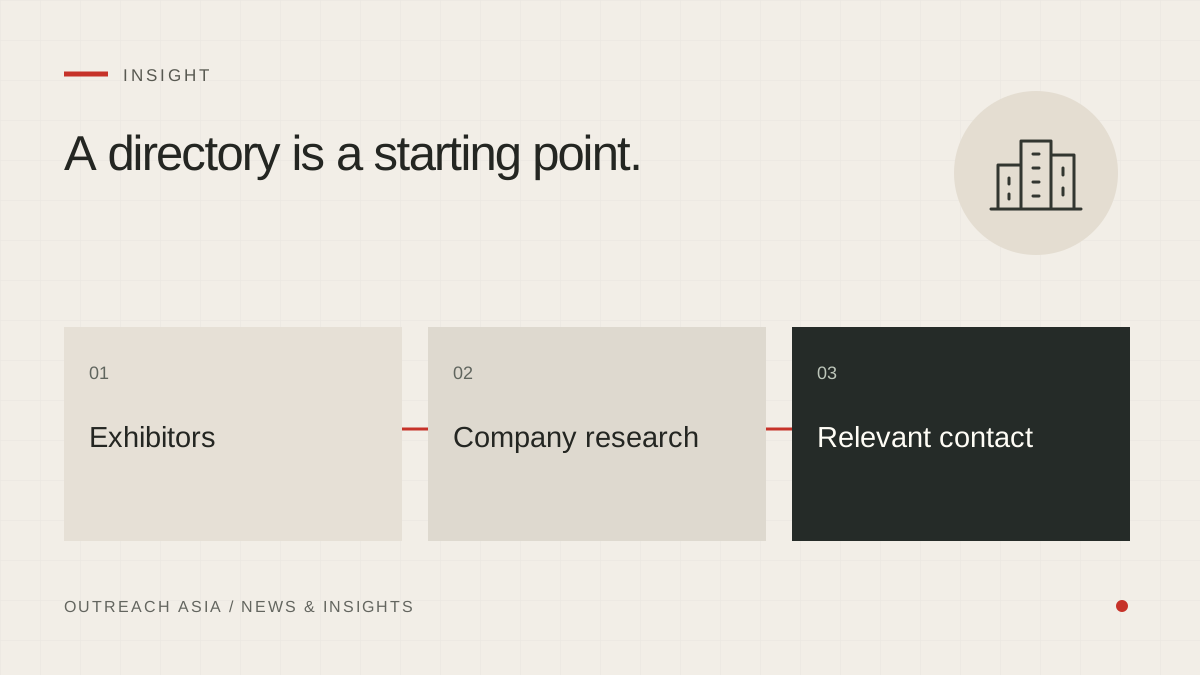
A visual summary of this article. Read the full explanation below.
This is general information, not legal advice. Laws and official guidance change. Check the current position, and take advice on your own circumstances, before acting.
Know who is on the list
Exhibitors are, for the most part, sellers. At a food fair they are manufacturers, brand owners, importers and distributors promoting ranges. If you are looking for distributors, some exhibitors are exactly that. If you are looking for end buyers, most exhibitors are not them, and some are competitors.
Take MIHAS, the Malaysia International Halal Showcase organised by MATRADE in Kuala Lumpur, as an example of a large sector fair. Its exhibitors span many product categories and countries. Reading such a list for companies whose own activities match your campaign criteria is more useful than treating everyone on it as a lead. We have no partnership with MIHAS or any other fair organiser; the name is used as an illustration.
Before the fair
If you are attending, the weeks before the fair are the time to research exhibitors and request short meetings. Say that you will be at the fair, what you would like to discuss and how long it would take. A meeting agreed in advance is usually more productive than hoping to catch the right person at a busy stand.
If you are not attending, the list is still a map of who is active in the sector. Research each company from its own website, not only from its directory entry.
After the fair
After the fair, refer to it only in ways that are true. If you met someone, say so. If you did not, do not imply that you did: “I saw you exhibited at the fair” is honest, “Following our conversation at the fair” is not. A short message that references what the company showed and asks one question fits the moment.
Great to meet you at the fair last week. As discussed, here is our price list.
Your company exhibited sauces and condiments at the fair last week. Do you review additional suppliers for your food-service range?
Terms and data rules
Read the organiser’s terms for the exhibitor directory. Some directories restrict how listings may be used, including for unsolicited marketing. The usual data protection rules also continue to apply to any personal details the list contains. The cautious approach is to use the list to identify companies, then take the contact route from each company’s own website.
Keep the list tidy
Exhibitor lists often contain duplicates, parent companies alongside their subsidiaries, and companies that exhibit under a brand name different from their registered name. Before contacting anyone, merge duplicates and decide which entity is the right one to approach. If a group and its local distributor both appear, contact one of them first, not both on the same day.
Record the source for each company, including the fair and the year. When a company asks how you found it, “your listing in the exhibitor directory” is a clear and honest answer.
How we apply this
Outreach Asia’s research can use trade-show and exhibitor lists alongside business listings and directories to identify companies. Each company’s own website is then read, and contact addresses come only from that website. Each lead is scored against the campaign criteria with a written reason, and every first message waits 24 hours for review.
Before you move on.
- You know whether exhibitors are buyers, distributors or competitors for you.
- Meetings are requested before the fair, with a clear purpose.
- Follow-ups describe contact at the fair accurately.
- The directory’s terms have been read.
- Contact routes come from each company’s own website.
This is general information, not legal advice. Outreach Asia describes its own rules and practices here; they are not a statement that any particular campaign complies with the law.