

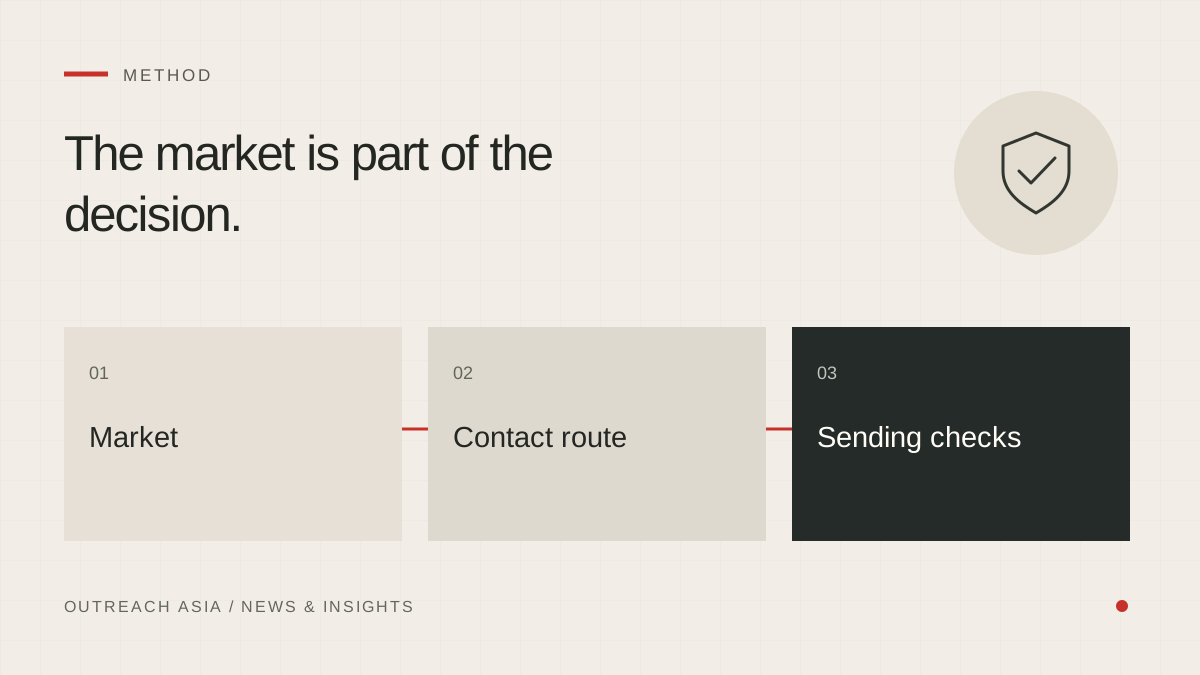
When a campaign covers several countries, the rules that apply are not the same in each. We decided early that those rules should be enforced by the software, the same way every time, rather than weighed afresh by a person or an AI model for each company.
The market is part of the decision.
- Identify the market
The company’s country determines the applicable rule.
- Apply the rule
An unreviewed or unsupported country is blocked.
- Check the recipient
Contact route and do-not-contact checks still apply.
- Explain the outcome
Show the reason when a first email cannot proceed.
A visual summary of this article. Read the full explanation below.
Why the rules live in the software.
A rule written into the sending path does not get tired, does not make exceptions under deadline and does not change its mind because a company looks promising. When the rule says no, the company is marked as not permitted for email and the reason is shown next to it.
The same applies to a market we have no rule for. A country without a rule on file is blocked until it has been reviewed. That is the safe default.
The five markets we serve.
Outreach Asia serves companies selling into Malaysia, Singapore, Indonesia, Thailand and the Philippines. Each has its own data-protection law, and the app applies a short rule for each one.
| Market | How the rule works in the app |
|---|---|
| Malaysia | Personal Data Protection Act 2010. Consent-based for direct marketing to individuals. Opt-outs are honoured immediately. |
| Singapore | PDPA and the Spam Control Act. The Spam Control Act expects unsubscribe requests to take effect within 10 business days; the app acts on them immediately. |
| Indonesia | Personal Data Protection Law No. 27 of 2022, which is consent-led. Generic company inboxes only; personal webmail addresses are avoided. |
| Thailand | PDPA (enacted 2019, in force 2022). A legitimate-interest basis is documented before a named person is contacted. |
| The Philippines | Data Privacy Act of 2012. Legitimate interest is available as a basis, and objection rights apply. |
Company inboxes by default.
In every market we serve, we write to a company’s published business inbox, such as a sales or enquiries address, rather than to a named person. A named individual’s address is personal data in all five markets, so the app keeps to role addresses unless a client deliberately turns that on.
Contact addresses come only from the company’s own website. We do not use bought lists.
Why Vietnam is not served.
Vietnam regulates advertising email differently. Its rules on advertising messages (Decree 91/2020) require the recipient’s prior consent, so the difference between a company inbox and a named person does not help. Cold email to Vietnamese companies is blocked in the app.
We could have kept Vietnam on the list and produced research anyway. But research that nobody can act on is not a service. So Vietnam is switched off until there is a route we can stand behind, rather than sold and then quietly not delivered. We have also stopped describing a company’s own enquiry form as a compliant alternative. It may carry lower exposure, but it is not a substitute for consent.
What is the same everywhere.
- A request to stop ends all contact at once, on every channel.
- One do-not-contact list is shared across all clients.
- Every email identifies the sender and carries a postal address. A letter with no address, or with a placeholder in its place, is refused.
- Every email has a one-click unsubscribe that mail clients understand.
- Daily limits and a gradual warm-up apply to every sending mailbox.
What these rules are, and are not.
These rules are orientation, written so that the app behaves conservatively. They are not a legal opinion, and they do not replace advice for your business. If you plan a campaign at volume, confirm the position with local counsel first.
This is general information, not legal advice. Editorial description of how Outreach Asia approaches the work. Examples are illustrative. Nothing here is a guarantee of replies, meetings or inbox placement.