

A list of company names is easy to produce. A list worth writing to is not. This note explains how Outreach Asia decides which companies to put in front of you, and what stops a company being contacted even when it looks like a good fit.
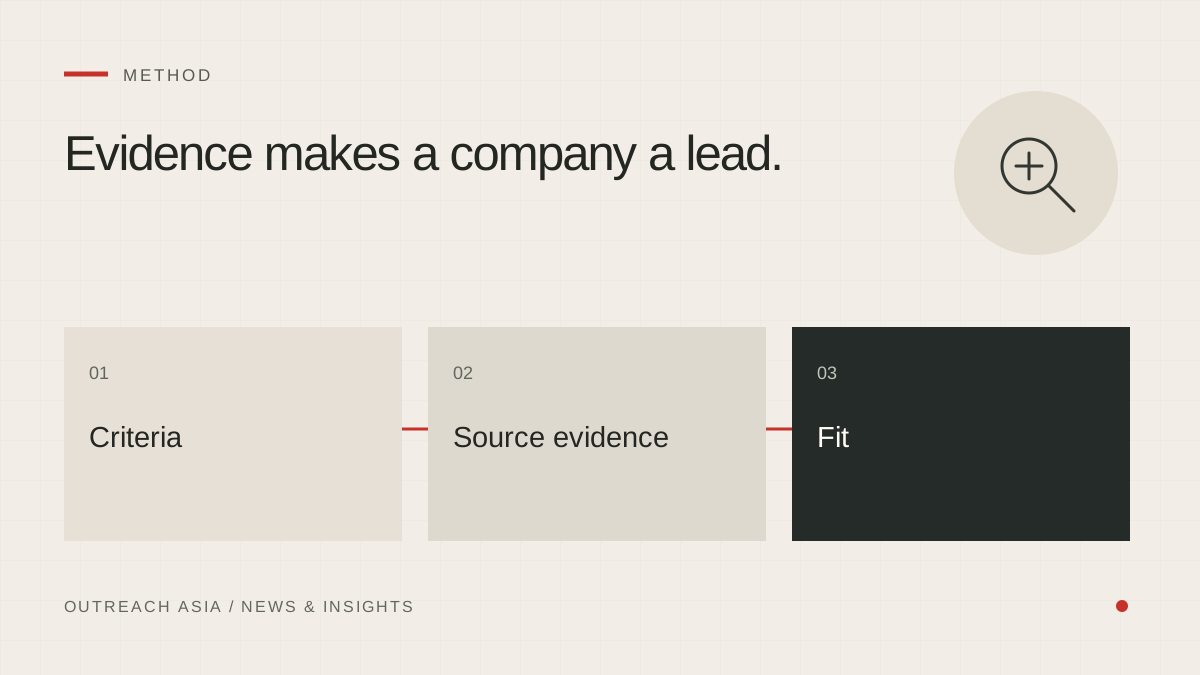
Evidence makes a company a lead.
- Campaign criteria
Define the role, sector, products and market that matter.
- Company sources
Read the company’s own website and keep the evidence.
- Fit and reasoning
Explain what is supported and what is still unproven.
- Contact checks
A fit score alone does not make a company contactable.
A visual summary of this article. Read the full explanation below.
Start from the campaign.
Research always begins with a campaign. Each campaign has a purpose: find buyers, find distributors or partners, sell more to existing customers, or win back past customers. It also names an audience, an angle and a call to action.
Most importantly, it has qualification criteria. These are the conditions a company must meet before we would suggest it, such as the products it carries, the sector it serves or the area it covers. Up to three campaigns can run at once, and each is researched against its own criteria.
Find real companies from sources a person can check.
We look for companies in places you could check for yourself: business listings and Google Maps search data, industry and association directories, and trade-show exhibitor lists. A name from any of these is only a starting point.
We then read the company’s own website. That is where most of the evidence comes from, and it is the only place we take a contact address from. If a company does not publish a business inbox on its own site, we do not go looking for one elsewhere.
Evidence before a score.
For each criterion, the research looks for evidence on the company’s own pages: a product range, the brands it carries, a service area, a statement about who it supplies. Each piece of evidence is kept with the page it came from, so you can open the source and judge it yourself.
A criterion without evidence counts as not met. We do not fill gaps with assumptions about what a company of that size or sector probably does.
Priority, Contactable or Below.
The evidence produces a score, and the score places each company in one of three bands.
- Priority: the evidence is strong across the campaign’s criteria. These are the companies to write to first.
- Contactable: the company fits well enough to contact, with some criteria less clearly shown.
- Below: the evidence falls short of the campaign’s bar.
If you use autopilot, you can limit it to the bands you choose, for example Priority only. Everything else waits for a person to decide.
“Why this one”, in plain words.
Every suggested company carries a short written reason: why this company, for this campaign. It names the evidence rather than a general impression. You can read it on the company’s page and beside its draft.
The reason is there so that you can disagree with it. If it does not convince you, skip the company. Skipping takes one click during review, and nothing is sent.
What stops a company being contacted.
A company can meet every criterion and still not be contacted. The common reasons are simple:
- It does not publish a business inbox on its own website.
- Its domain has no mail server, so anything sent would bounce.
- The only address is a special-purpose inbox, such as privacy, abuse or no-reply.
- The rules for its country do not allow a first email.
- It is on the shared do-not-contact list, which applies across every client.
- Another client has written to it recently. A company is held for 90 days after a first contact, so it does not hear from two of our clients in quick succession.
Editorial description of how Outreach Asia approaches the work. Examples are illustrative. Nothing here is a guarantee of replies, meetings or inbox placement.