

These numbers are small. They come from one month, a handful of clients and very different industries, so they say little about what to expect at scale. We share them because they are real, and because each lesson changed how we work.
Early lessons, carefully read.
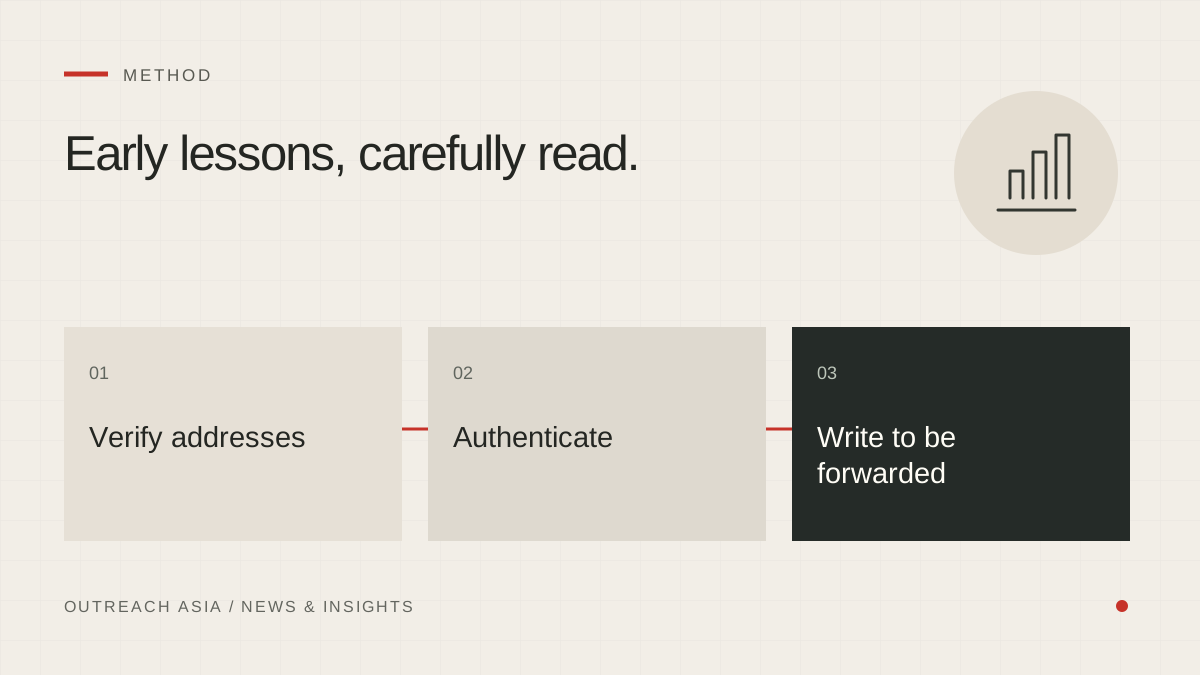
- Verify contacts
Check the source and the receiving mail domain.
- Authenticate sending
Check domain records and a real test message.
- Help the first reader
Make the email easy to understand and forward.
Conceptual stages, not measured conversion rates.
The figures.
- 94 companies received a first email across 5 client workspaces.
- 7 replied, which is 7.4%.
- 4 of those were interested. They asked for a catalogue, a company profile, a vendor registration or a partnership discussion.
A reply here means a person answering, not an out-of-office message or an automatic acknowledgement. Interested means the company asked for something concrete.
What the replies looked like.
A China-based frozen-food manufacturer emailed 44 companies in Malaysia and received 5 replies. A food distributor in Kuching and the purchasing manager of a resort in Johor asked for the catalogue. A supermarket chain’s customer team referred the proposal to its purchasing team.
A digital pregnancy-care platform received its first reply from a Malaysian clinic-software company open to a partnership discussion, and answered it with a company overview within minutes. A window-film company was invited by a facilities-management group to register as a vendor.
We do not name the clients or the companies that replied, and we do not quote anyone.
Lesson one: verify addresses before sending.
7% of first emails hard-bounced. Each bounce is a wasted first impression, and a high bounce rate harms the sending mailbox’s standing. Addresses now have to come from the company’s own website, the domain is checked for a mail server before anything is sent, and a hard bounce puts the address on the do-not-contact list.
Lesson two: set up SPF, DKIM and DMARC first.
One sending domain had no SPF, DKIM or DMARC records, and it received no replies. One domain proves nothing on its own, and other things differed too. But there is no good reason to send without these records, so we now check them whenever a client connects its own mailbox.
Lesson three: the first reader is often a shared inbox.
83% of first emails went to generic inboxes such as info@ or sales@. That follows from our rules: we write to published business inboxes rather than named people. It means the first reader is often not the decision-maker. A good first email has to make sense to whoever opens it and be easy to forward. The supermarket referral above is what that looks like when it works.
What these numbers do not show.
They are not a forecast, a benchmark or a promise. A different industry, market or offer could produce very different results, and nobody can guarantee a reply. What the numbers do show is that careful research and plain, accurate emails can start real conversations, and that the technical basics matter from the first send.
Editorial description of how Outreach Asia approaches the work. Examples are illustrative. Nothing here is a guarantee of replies, meetings or inbox placement.